
Nasscom's newly appointed Chairman, Srikanth Velamakanni, outlines key priorities including restoring revenue growth in IT firms and promoting the role of artificial intelligence and other technologies in companies.

'Periods of geopolitical uncertainty often see a rise in coordinated cyber threats, disinformation campaigns, and infrastructure targeting.'

Nasscom President Rajesh Nambiar highlights India's growing importance as a technology partner due to geopolitical uncertainties and the need for resilient supply chains.
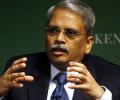
Infosys co-founder Kris Gopalakrishnan urges Indian startups to focus on deep technology and advanced manufacturing to ensure strategic autonomy.

The rapid development of artificial intelligence (AI) globally presents significant opportunities for Indian companies and will not adversely impact their businesses, Nasscom AI head Ankit Bose said on Tuesday.

India's newly formed Artificial Intelligence Governance and Economic Group (AIGEG) is set to advocate for a unified legal framework for AI companies, including developers of large language models and chatbot systems, alongside broader operational rules.

Union Minister Ashwini Vaishnaw highlights the growing demand for AI-related jobs in India and the transformation needed in the IT industry. He also mentions significant investments in data centres and subsea cable networks to boost digital infrastructure.

Haryana's Chief Minister Nayab Singh Saini reviewed the progress of the Haryana AI Development Programme (HAIDP), a Rs 474-crore initiative developed with the World Bank, focusing on AI skilling, startup incubation, and ethical AI governance.

'When it comes to enterprise context, there is a big lag between how fast technology is evolving and how it is getting deployed at the end of the day. That is where the challenge is going to be.'

Delhi LG Taranjit Singh Sandhu addressed the Global Confluence 2026, emphasising the importance of maintaining a human element at the heart of digital nation-building. He highlighted India's digital transformation and the role of technology in improving lives, while urging a focus on inclusive development and national security.

'The reality is that every one of us will be pushed to learn and relearn faster than ever before. Some people will rise to that challenge. Some may not. But the opportunity itself is massive,' says Noshir Kaka, senior partner, McKinsey.
India's digital economy is projected to constitute nearly 20 per cent of the nation's GDP by 2030, fuelled by a growth rate twice as fast as the overall economy, according to a senior government official.

The India-US trade deal has offered a much-needed breather for the Indian information technology (IT) industry, which has been grappling with global macroeconomic uncertainty and subdued client spending over the past few years.

A key industry leader acknowledged the India IT services sector faces a "painful" transition due to AI, but emphasized the industry's resilience and ability to adapt through reinvention and focusing on complex enterprise technology.
A key industry leader acknowledged the India IT services sector faces a "painful" transition due to AI, but emphasized the industry's resilience and ability to adapt through reinvention and focusing on complex enterprise technology.

Top female executives are calling for corporate India to redesign workplace systems to support women's advancement into leadership roles in the technology sector, particularly in emerging fields like artificial intelligence.

The message is becoming clearer: Employees who fail to meaningfully integrate AI into their work risk falling behind in performance assessments.

Infosys on Tuesday unveiled its AI First Value Framework, positioning itself to capture an estimated $300-400 billion incremental AI services opportunity by 2030, as global enterprises accelerate adoption of generative and agentic AI.

India launches AI-driven SPEEED platform to track athlete performance, predict injuries, tackle age fraud and revolutionise sports science nationwide.
Concerns have emerged about the impact of AI adoption on young workers, particularly those seeking their first job in high-skilled occupations.
India Inc on Sunday hailed the Union Budget 2026-27 as a 'structural shift' in the country's technology landscape, noting that the government is moving beyond fragmented pilots to build foundational layers where AI serves as a 'horizontal enabler' for the entire economy.

With discretionary spending still under pressure, the information technology (IT) services industry continued to face an uncertain demand environment in the third quarter of 2025-26 (Q3FY26).

The Union Budget on Sunday proposed a tax holiday till 2047 for foreign companies that provide cloud services to customers globally using data centres located in India, signalling the government's push to make the country a major hub for AI and digital infrastructure.
The Union Budget on Sunday proposed a tax holiday till 2047 for foreign companies that provide cloud services to customers globally using data centres located in India, signalling the government's push to make the country a major hub for AI and digital infrastructure.

The US has replaced random H-1B selection with a wage-weighted lottery and a new $100,000 fee for applications, raising uncertainty for students and junior hires.

'We frequently discuss AI, but we're waiting for other countries to develop solutions rather than creating intellectual property ourselves.' 'We haven't yet produced comprehensive AI solutions developed in India for global markets.'
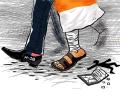
India's $280-billion IT industry heads into 2026, balancing visa-related headwinds and global trade uncertainty against its biggest-ever push into artificial intelligence and the rapid expansion of global capability centres (GCCs). Heightened scrutiny of the US H-1B visa programme - including a proposed $100,000 fee for new visas and concerns over a potential 25 per cent outsourcing tax - has complicated cross-border delivery for Indian firms, even as companies accelerate efforts to reduce reliance on onsite staffing.

To turn disruption into opportunity, NITI Aayog has recommended the launch of a National AI Talent Mission to make India the AI workforce capital of the world.

United States, the largest market for the $282 billion Indian IT sector, is a "wild card" for the industry, lobby grouping Nasssom's president Rajesh Nambiar said on Monday. Speaking to reporters Nambiar said the tariff threats by the US may turn out to be the biggest headwind for the sector. "Broadly, if you were to look at the headwinds, the biggest unknown there would be the tariffs and the impact of what happens in the US market," Nambiar said.

Efforts are underway to integrate AI education into all degree programmes -- including BA, BCom, BSc, and specialised courses.

Joining the debate on working hours, IT services company Capgemini India's chief executive Ashwin Yardi on Tuesday advocated 47.5 hours work per week, and was against sending e-mails to employees on weekends. He was speaking at Nasscom Technology and Leadership Forum (NTLF) in Mumbai.

Yamuna Kalyani reveals how she battled stereotypes to build UniteAR, an augmented reality platform that helps users create interactive AR experiences for personal and commercial purposes.
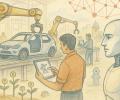
Physical AI equips machines with the ability to perceive, learn, and act in the real world by integrating AI algorithms with sensors and actuators in physical systems like robots and vehicles.
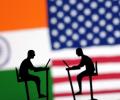
The Indian team has returned from the US after holding trade talks with their American counterparts in New York, an official said on Thursday. Commerce and Industry Minister Piyush Goyal, who led the team, will be back on Friday.

'Employers increasingly want candidates who can take AI pilots from proof-of-concept to production-ready systems.' 'That requires governance, monitoring, and ROI measurement -- skills that go beyond coding and into business impact.'

'...are young Indians with aspiration to go to the US.' 'The dream has to be more about working in India...'

People with no knowledge of coding or computer languages can use vibe coding using plain English command with AI-assisted software development.

'People are taking effort to train and adapt to current skills.' 'If that is not there, they are not useful to us.' 'They have to adapt to new technology, and what is important is learnability.'

Nasscom has identified 4-5 different areas and is taking these recommendations to the government.

P V Sindhu said dealing with the rigours of training, disappointment as well as success is an ongoing process and an athlete must stick to it.
 © 2026 Rediff.com - Advertise with us - Disclaimer - Privacy Policy - Sitemap - Feedback - About us - Terms of use - Grievances